
Bone Density Test:
Who Needs One and Is It Covered by OHIP?
A Bone Density test measures how strong your bones are. Here's who Osteoporosis Canada says should have one, how to prepare, what the scan is like and what OHIP covers.
Key points
- Osteoporosis Canada recommends a Bone Density test for all women and men aged 70 and over, and earlier for people with fracture risk factors.
- With a valid health card and a requisition, it is covered by OHIP in full. Without OHIP, it is $194 as of October 2026.
- The scan takes about 15 minutes. You stay dressed and lie still on an open table. Skip calcium supplements for 24 hours before.
A Bone Density test, also called a bone mineral density (BMD) test, measures how strong your bones are, usually at the hip and spine. Osteoporosis Canada recommends one for everyone aged 70 and over, and earlier for people with fracture risk factors. With a valid Ontario health card and a requisition from your doctor, it’s covered by OHIP.
Here’s what the test measures, who needs one, what it costs without OHIP, and what the 15 minute appointment is like.
What does a Bone Density test measure?
Bone loss usually happens silently. You can’t feel your bones getting thinner, and many people only find out they have osteoporosis after a fracture. A BMD test catches that loss early. The most common method is called DXA (or DEXA): a low-dose scan of the hip and spine that measures how much mineral is packed into your bones.
Your result is given as a T-score, which compares your bone density with that of a healthy young adult. Osteoporosis Canada explains the ranges: normal is no more than 1 standard deviation below the young adult value, between 1 and 2.5 below is low bone density (osteopenia), and more than 2.5 below indicates osteoporosis. A radiologist reads your scan and sends the report to your doctor within 24 to 48 hours. Your doctor looks at the T-score together with your age, history and other risk factors, and explains what it means for you.
Who needs a Bone Density test?
Osteoporosis Canada groups its testing recommendations by age and risk:
| Who | Guidance |
|---|---|
| Women and men 70 and older | Test all |
| Postmenopausal women and men aged 65 to 69 | Test with 1 risk factor for fracture |
| Postmenopausal women and men aged 50 to 64 | Test after a previous low-trauma fracture, or with 2 or more risk factors |
| Adults under 50 | Test only with a disease or condition linked to low bone mass or bone loss |
Risk factors can include a past fracture from a minor fall, a parent who broke a hip, certain long-term medicines and some medical conditions, and your doctor weighs them with you. If you’re approaching 65, or you’ve gone through menopause and any of these apply, bring it up at your next check-up. A Bone Density test is ordered by your doctor or nurse practitioner, so the conversation starts there.
Is a Bone Density test covered by OHIP?
Yes. With a valid requisition, OHIP covers bone mineral density testing in full. There is no co-payment, no facility fee and nothing to claim back. Bluewater accepts a valid requisition from any licensed Ontario healthcare provider, on any form. Read Do you need a requisition for an X-Ray or Ultrasound in Ontario? for how requisitions work.
OHIP also has rules about how often repeat tests are covered. Osteoporosis Canada reports that since April 1, 2026, most patients may not have another covered BMD test until 3 years after their previous one, with exceptions for people on high-dose glucocorticoids and some other conditions. It also notes that self-funding a medically necessary BMD test isn’t allowed under OHIP rules. Your doctor will know when your next test is due.
If you don’t have OHIP coverage, the self-pay price for a bone densitometry test is $194 as of October 2026, from our cash fee schedule.
How do I prepare for a Bone Density test?
Bluewater’s instructions are short:
- Wear no metal in or on your clothing: no zippers, underwire bras or metal fasteners. A two-piece outfit is easiest.
- Do not take calcium supplements for at least 24 hours before your test.
- Bring a list of your supplements and medications.
- Tell us if you had a barium study in the last week.
- Tell us before the exam if you are pregnant or might be.
Bring your health card and your signed requisition, and arrive 15 minutes early. The full list is on our preparation instructions page.
How long does it take, and what happens?
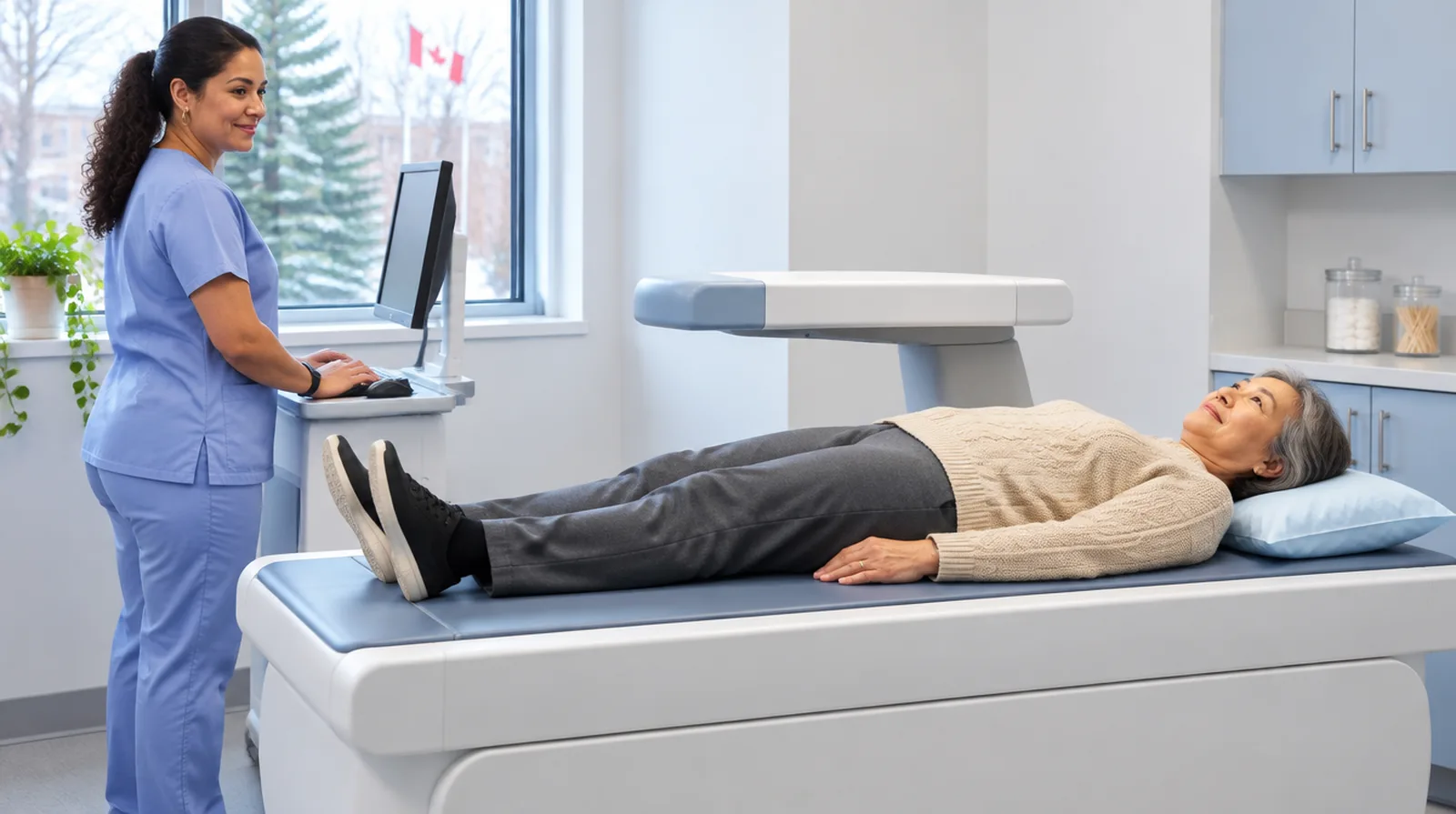
About 15 minutes. You lie on your back on an open, padded table, fully dressed. A scanner arm passes slowly over your hip and spine while you lie still and breathe normally. It doesn’t touch you, and you won’t feel anything.
The radiation dose is extremely low. Osteoporosis Canada compares it to the amount you’d receive on a flight from Toronto to Vancouver.
Is this the same as a DEXA body composition scan?
No. Bluewater also offers a DEXA body composition scan, a self-pay scan ($129) that reports bone density with a T-score along with body fat, lean mass and visceral fat. It needs no referral, and online booking for it is coming soon. If your doctor has ordered a Bone Density test for osteoporosis, book the OHIP-covered BMD test, not the body composition scan.
Where can I have a Bone Density test?
Bone mineral density testing is offered at four Bluewater clinics: 123 Edward Street in downtown Toronto, Lawrence & Dufferin in North York, Woodbridge and Port Hope.
Book your Bone Density test
Once you have your requisition, book online or call 416-462-0064. Hours and directions are on our locations page, and there’s more on our bone mineral density page.
This article is general information. Always follow the instructions from your doctor and your appointment confirmation.
Common questions
Who needs a Bone Density test?
Osteoporosis Canada recommends testing for all women and men aged 70 and over, postmenopausal women and men aged 65 to 69 with one fracture risk factor, those aged 50 to 64 with a previous low-trauma fracture or two or more risk factors, and younger adults with a condition linked to bone loss. Your doctor decides and writes the requisition.
Is a Bone Density test covered by OHIP?
Yes. With a valid Ontario health card and a requisition, OHIP covers bone mineral density testing in full, with no co-payment and no facility fee. Without OHIP, the self-pay price is $194 as of October 2026.
How do I prepare for a Bone Density test?
Do not take calcium supplements for at least 24 hours before your test. Wear no metal in or on your clothing, such as zippers, underwire bras or metal fasteners. Bring a list of your supplements and medications, and tell us if you had a barium study in the last week.
How long does a Bone Density test take?
About 15 minutes. You lie still on an open, padded table, fully dressed, while a scanner arm passes slowly over your hip and spine. It is painless and uses an extremely low dose of radiation.
Where can I have a Bone Density test at Bluewater?
At four clinics: 123 Edward Street in downtown Toronto, Lawrence & Dufferin in North York, Woodbridge and Port Hope. The report reaches your doctor in 24 to 48 hours.
Keep reading
Do You Need a Requisition for an X-Ray or Ultrasound in Ontario?
For an OHIP-covered X-Ray or ultrasound, you need a signed requisition from a licensed provider. Here's who can write one, what to bring, and the few exams you can book on your own.
Is My Ultrasound Covered by OHIP?
What's Free and What Isn't
With a valid Ontario health card and a requisition, a medically needed ultrasound costs you nothing. Here's what OHIP pays for, what it doesn't, and what to do if you're not covered.
How Much Does an X-Ray Cost Without OHIP in Ontario?
No health card? An X-Ray at Bluewater costs between $45 and a few hundred dollars depending on the body part and number of views. Here are real prices from our October 2026 fee schedule.